Category: Uncategorized
Greensboro Court Reporting

Located in the Piedmont region of North Carolina, Greensboro was settled in the 1750s by Quaker migrants from Pennsylvania. At that time it was known as Capefair, but was renamed after the Revolutionary War to honor Major Nathanael Greene. From the antebellum era until today, Greensboro has been a hub of the textile industry.
Greensboro is home to the University of North Carolina at Greensboro and to a historically black college, North Carolina A&T University. A&T students were a major force in the civil rights movement, including the Greensboro Four, who led sit-in’s at the lunch counter at the Woolworth’s downtown. That building is now the International Civil Rights Center and Museum.
When visiting Greensboro for depositions, in the downtown area we recommend the Marriott and Hyatt Place, and in the airport area we recommend Embassy Suites. Popular downtown restaurants include Dame’s Chicken and Waffles and Blue Denim. Near the airport, enjoy a hearty meal at Carolina’s Diner.
Legal Media Experts offers professional court reporting and videography services and deposition suites in Greensboro, High Point, and beyond. Contact us using our online scheduling tool or by phone at 800-446-1387 and we will make sure all of your needs are taken care of.
Lawyer Fined $50,000 for Inappropriate Deposition Questions
When taking depositions in any case, attorneys balance their zealous representation with their clients with adherence to ethical and professional guidelines. In family law cases, that adherence is even more important because minor children can suffer extreme “collateral” damage.
In a case out of Ventura County, California, a state appellate court upheld sanctions that had been imposed by a Ventura County, California judge against an attorney in a child custody case. The attorney’s questions, the judge ruled, exposed confidential information gleaned from court-ordered custody evaluations to those who shouldn’t have access to such information.
“[The opinion] affirmed the sanction slapped on attorney Lisa H. Meyer of Los Angeles but reverses the order rendering Meyer’s client jointly and severally liable.
Meyer asked Yeager several questions related to a child custody evaluation ordered by the court in the proceeding, which included a psychological report on the child.”
In general, information from child custody evaluations or psychological reports in child custody and/or visitation proceedings is confidential unless it falls under narrow exemptions. If the disclosure isn’t exempt, the Court can sanction attorneys and parties.
“Family Code §3111(d) permits the court to impose sanctions upon a determination that ‘an unwarranted disclosure of a written confidential report has been made….’ Sec. 3111(f) states that ‘a disclosure is unwarranted if it is done either recklessly or maliciously, and is not in the best interests of the child.'”
Meyer’s contention that this rule “applies only to protect the written report itself, and not the information contained in it,” was “absurd,” Presiding Judge Arthur Gilbert said. He said that while attorneys must serve their clients vigorously, their advocacy must also “be tempered by the professional and ethical constraints the legal profession demands,” and, “unfortunately, that did not happen here.”
Durham Court Reporting

Durham was a sleepy Southern town prior to the Civil War, but was built by tobacco and textiles during the post-Civil War era. One of the world’s largest corporations, American Tobacco, was founded here by Washington Duke. Trinity College, which was brought to Durham thanks to Duke’s generosity, was renamed Duke University nearly 20 years after his death. The Duke family also started textile mills in the area and expanded throughout the state. While the tobacco warehouses aren’t used for tobacco anymore, they’ve been repurposed and house some of the city’s best restaurants, art galleries, and shops. The Duke institution that brings most attorneys to Durham, though, is world-renowned Duke University Medical Center.
Our Durham office, located on Broad Street near the NC School of Science & Math, is close to shopping and dining on Ninth Street, including top-rated Parizade. For lodging, in the downtown area we recommend the Durham Marriott City Center. Closer to the Research Triangle Park, at Southpoint, we recommend Hyatt Place.
If you have some extra time while you’re in Durham, check out the gorgeous Sarah P. Duke Gardens at Duke University, the Duke Basketball Museum, or, depending on the time of year, catch a minor league baseball game at the Durham Bulls Athletic Park.
Legal Media Experts provides deposition suites and professional court reporters and videographers in Durham, and we would be honored to handle all of your deposition needs in the Durham area. Schedule today using our online form or call the office at 800-446-1387 and we will make sure you’re taken care of.
Fired Court Reporter Blames His Misconduct on Court Clerk

After the head court reporter in Manhattan’s civil courts was dismissed from his job, he filed a wrongful termination suit against his former employer giving an unusual reason for his misconduct.
John Phelps filed suit against the New York State Unified Court system seeking reinstatement to his job. He formerly supervised approximately 60 people working in four state courthouses. As a supervisor, he was to only “rarely” transcribe cases, but the judge who determined Phelps should be dismissed characterized him as a “bully” who threatened his subordinates.
According to the court documents, some colleagues testified in Phelps’ defense and spoke highly of him, but other witnesses said he did little actual supervising and took home tens of thousands of dollars per year by disregarding the part of his job description that said he should only “rarely” transcribe proceedings.
“As one who has devoted over half a century to public service, it is not easy to recommend the termination of employment of another public servant,” wrote Joseph Fisch, a retired judge who heard the court system’s case against Phelps. “But I cannot faithfully discharge my responsibility … by failing to take notice of the portrait of respondent that emerged after the evidence presented to me.”
Fisch wrote that Phelps was a “bully” who threatened to fire employees who crossed him. In addition, according to Fisch, Phelps “brazenly proclaimed his unqualified disdain for non-lucrative reporting work,” by saying, “I don’t do pro se” when he learned a party was self-represented and less likely to order a transcript.
In addition to his actions related to subordinates, Phelps was accused of misappropriating funds from an account the office had set up to buy gifts for judges and judicial staff.
According to the judicial hearing officer’s decision, Phelps was chronically late, delegated much of his administrative work to a “deputy” and picked plum reporting jobs for himself. He also “borrowed” thousands of dollars from an account meant to buy gifts for judges and his staff and pleaded guilty to misdemeanor petty theft in connection with his use of that money.
Phelps claims that “the court system crossed a line” by firing him, and says that the (now retired) Chief Clerk of the Manhattan Supreme Court Civil Term, John Werner, gave him permission to “work with referees or take daily assignments from judges” – the “plum” assignments, as evidenced by an email Phelps produced in which Werner said it was “no problem” for Phelps to take such assignments. However, it’s unclear whether Werner understood what that meant to the other court reporters in Phelps’ office, who were paid much less than Phelps, to have their boss competing with them financially, and whether Werner meant Phelps had carte blanche to take as many plum assignments as he wanted.
Chapel Hill Court Reporting

Chapel Hill is the quintessential college town with Southern hospitality. As the home of the UNC Tar Heels, Carolina blue is visible just about everywhere you turn – and wearing Duke blue is not highly recommended. The town’s economy revolves around the university and UNC Hospitals, and the social center is Franklin Street.
When staying in Chapel Hill, we recommend the Carolina Inn, the Franklin Hotel, or Aloft. If you have any free time, or are looking for a place to grab a bite, Top of the Hill on Franklin Street is legendary, as are Mama Dip’s and Merritt’s Grill. If the UNC Men’s Basketball team is in town and you think you might want to catch the game, we just have two words to say: Good luck. Tickets are almost impossible to come by. But, you never know!
AB5 and Court Reporters

California’s disastrous anti-freelancing bill, AB5, went into effect January 1, 2020 and is already having a detrimental effect on the state’s freelance court reporters and agencies. One such agency, Diamond Court Reporting, has filed suit against the state.
In a nutshell, AB5 creates a presumption that any person providing their labor or services to a company for remuneration is an employee.
Asm. Lorena Gonzalez, the bill’s author, claims that the law was intended to codify the Dynamex decision, referring to a California Supreme Court case regarding truck drivers who had been employees but were then transitioned to independent contractor status. Two of the affected drivers decided they’d rather go back to employee status and filed a misclassification suit against the company. In ruling against Dynamex, the California Supreme Court set out an “A, B, C” standard to determine if a worker is an independent contractor or should be an employee. To qualify for independent contractor status, all of the following parts must be met:
A. the worker is free from the control and direction of the hiring company “in connection with the performance of the work, both under the contract for the performance of the work and in fact”;
B. the worker performs work that is outside the usual course of the hiring company’s business”; and
C. the worker is “customarily engaged in an independently established trade, occupation, or business of the same nature” as the work performed for the hiring entity.
AB5 goes a bit further, though. Prior to AB5, any tests to determine whether someone was an independent contractor or an employee did not apply to people whose positions or professions were not controlled by “wage orders.” Court reporters, as professionals licensed by a state board, were not controlled by wage orders. Under AB5 anyone earning even one dollar in the state and whose line of work isn’t specifically exempted must be able to pass the A, B, C test. Lawyers are exempted, but court reporters, translators, and interpreters – who frequently work on-demand – are not.
That is a pretty big problem for Diamond Court Reporting.
Multiple industry groups have filed suit against the state on behalf of the professions they represent, but the case of Diamond Court Reporting is a little different in that the court reporting firm holds eight contracts with various state and federal government departments to provide on-demand court reporting services. Many of their contracts require them to provide statewide coverage, and in a state as large as California, they argue, there is no way they can provide that service in the manner needed by the government agencies without maintaining a list of independent contractor court reporters they can engage on a job-by-job basis.Should their client be in the position of prosecuting or fining them for not complying with an impossible-to-comply-with law?
In their Complaint for Declaratory Relief, they describe the irreconcilable conflict:
“[N]o express exemption is provided for a court‐reporting business such as Plaintiff’s to retain licensed professional California Court Reporters (CSRs) on an individual, on-demand, single matter basis, and therefore Plaintiff is presently and immediately threatened with prosecution in a civil action against Plaintiff as the putative employer by said Defendants for purported misclassification of Plaintiff’s independently contracted CSRs as an independent contractor.”
The Complaint states that compliance with the law as presently constituted prevents Plaintiff from being able to perform the contracted services, effectively causing them to breach the contract. So, they’re forced to choose between a breach of contract suit or being sued by the state for misclassification. That’s quite a conflict.
Additionally, since many other state board licensed professionals are exempted, Diamond Court Reporting claims that court reporters as a class of professionals are treated disparately and with no rational basis for that treatment.
Finally, the Plaintiff argues that the new law burdens them with new obligations that other similar professions don’t face, and that such treatment is “arbitrary, irrational, and capricious,” thereby violating the Equal Protection Clause of the United States Constitution.
As of this writing, there is no legal challenge to the law on behalf of court reporters as a whole.
Videoconferenced Depositions via Zoom

The practice of taking depositions via videoconference has been steadily growing for years for economic reasons, but we’ve recently seen a big upswing in attorneys choosing to almost exclusively use videoconferencing to take depositions because air travel can be so unpredictable and is ever-more time consuming. At Legal Media Experts, we’ve been providing videoconferencing services for depositions for more than a decade, so we’ve learned a thing or two about what makes for a great videoconference deposition.
We currently use Zoom to provide videoconferencing services nationwide, and we’ve come up with some “best practices” and some helpful hints for your next Zoom videoconference deposition:
• Plan to be at your desk at least 15 minutes before the scheduled start time. At that time go ahead and join the Zoom meeting even if other participants aren’t there yet. That way, if there are technical difficulties they can be resolved without causing the deposition to start late.
• Consider investing in an external USB microphone and headphones. They’re inexpensive (as low as $20 on Amazon) and will serve to minimize “room noises” that could make it difficult for other participants – and the court reporter – to clearly hear each word that’s said.
• Location, location, location! Ideally, you will join the Zoom meeting from a room in which you have a hardwired high speed internet connection. Also, avoid sitting near a bright window or in an area where loud noises can repeatedly interrupt you.
• Keep your mic on if you plan to speak – but don’t multitask. If you are typing away at your keyboard or having a snack, everyone will hear you. Sometimes one or more participants will have to mute when they’re not speaking because of audio interference. If that happens, just be sure you un-mute when you need to make an objection or comment.
• Ensure that only one person speaks at a time. That’s an evergreen best practice but it’s especially important in a videoconference deposition. Inevitably the court reporter will have to interrupt and have each person re-state what they said, which is frustrating for everyone and causes the deposition to last longer.
• Have your exhibits open on your computer, in PDF format, to easily and quickly present them to the witness. Through Zoom you can share your screen, or only selected windows, with other participants. If you have your exhibit folder already open on your desktop, with just a few clicks you can refer to a particular exhibit and never have to wonder if the witness is looking at the right document. (These exhibits should also be emailed to us at least two days prior to the deposition to ensure that the court reporter has a hard copy of them on site.)
• Even if it’s not a videotaped deposition, you could be recorded, so behave accordingly! One benefit of Zoom depositions is the ability to record the meeting right there in the app. This can be very helpful for trial prep.
Legal Media Experts’ court reporters and videographers participate in Zoom videoconference depositions nationwide on a daily basis, and our office staff is ready to help with any of your Zoom-related technical needs. Schedule your Zoom videoconference deposition today by using our online scheduling tool or calling 800-446-1387.
Santa Clarita Court Reporting

Santa Clarita
Santa Clarita, also known as “awesometown” was founded in 1987 when the unincorporated communities of Valencia, Newhall, Canyon Country, and Saugus banded together. The area was first settled by Spanish colonists in the 1700’s, and was the site of the first documented discovery of gold in California, at Placerita Canyon. People still pan for gold there today.
The Santa Clarita Valley served as Hollywood’s first “back lot,” and stars like Gene Autry, John Wayne, and Roy Rogers filmed hundreds of westerns at Melody Ranch, founded in 1915. Recently, the Deadwood Movie was filmed at the ranch. Santa Clarita today is a quintessential suburban town. It was used as the setting for the TV show “Weeds,” and, obviously, Netflix’s “Santa Clarita Diet.”
Walt Disney founded a four-year university in Santa Clarita, California Institute of the Arts. Many of Disney’s animators and Imagineers are CalArts grads, as is legendary actor and director Tim Burton.
For Santa Clarita lodging, we recommend the Embassy Suites or the Hyatt Regency. You can enjoy a fabulous meal at the Newhall Refinery or the Old Town Junction restaurant, both of which are located in Old Town Newhall. If you need to blow off a little stress after your deposition, you can hike at the unique and legendary Vazquez Rocks park or stop by Six Flags Magic Mountain, home of some of the world’s fastest roller coasters.
Legal Media Experts provides professional court reporting, legal videography, process serving, and videoconferencing services in the Santa Clarita Valley and nearby areas. Schedule your next deposition today at legalmediaexperts.com
Charlotte Court Reporting

Charlotte – The Queen City
Charlotte North Carolina, now the 25th largest city in the United States, was chartered in 1768 and named after Charlotte of Mecklenburg, wife of King George III. The settlers’ affection for the Crown quickly changed, and the first Declaration of Independence signed in the colonies was signed here on May 31, 1775. British Gen. Cornwallis called the city “a hornet’s nest of rebellion.”
Charlotte is known for all types of racing and is home to the Charlotte Motor Speedway and the NASCAR Hall of Fame and Museum, but the area’s main industry is banking. Multiple banks are headquartered in Uptown Charlotte, the city’s center. At the Charlotte Epicentre you’ll find numerous restaurants and entertainment options, including Bowlero, an upscale bowling alley. For great soul food, take short walk from any of the hotels in the city center to Mert’s. If you’re in town during football season you might be able to catch the Panthers at Bank of America Stadium.
Another area that’s popular for visitors to Charlotte is the South Park neighborhood. In South Park, we recommend the DoubleTree hotel, and locals rave about Café Monte and Pink Cactus (which carries 41 different tequilas!). During the summer, the Charlotte Symphony Orchestra performs in South Park.
Legal Media Experts has provided professional court reporting and legal videography services in Charlotte for more than a decade. To schedule your next deposition with us, use our online tool at legalmediaexperts.com.
ADA Needs CART Reporters
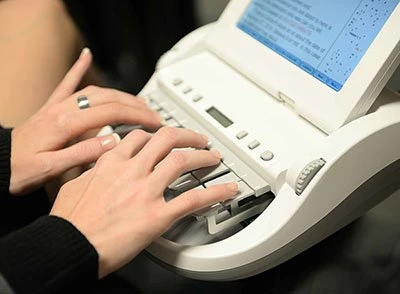
Did you know that in addition to their role as Guardians of the Record, court reporters perform a vital role in helping people with hearing impairment access to judicial proceedings?
Realtime court reporters who have obtained additional training and certification are able to provide CART – Communication Access Realtime Translation – services, which are similar to closed-captioning seen on television.
Under the Americans with Disabilities Act (ADA), federal, state, and local governments are required to provide “reasonable accommodations for employees and ‘auxiliary aids and services’ to ensure effective communication with people who are deaf or hard of hearing.”
The National Court Reporters Association (NCRA) describes CART services as “the instant translation of the spoken word into English text using a stenotype machine, notebook computer and realtime software.” The text produced by the CART service can be displayed on an individual’s computer monitor, projected onto a screen, combined with a video presentation to appear as captions, or otherwise made available using other transmission and display systems.
In a recent letter to the editor in a local newspaper, one man who has requested CART services from the courts in the past took the time to educate his neighbors about what CART is and how to go about requesting CART services themselves.
The ADA provides that courts and public entities must provide meaningful access to the hearing impaired, and not just American Sign Language. Under the ADA, if a hearing-impaired person makes his or her needs known, the courts must make every effort to accommodate the needs of that person, including, but not limited to ASL.
Little known, there is something called Communication Access Realtime Translation, in which a qualified certified court reporter is present in a court proceeding of public meeting, takes down what is being said and by whom, in realtime and the text of the proceeding appears on a monitor. Under the ADA, the public body must provide these and other services, at its cost, and must, wherever practical, honor the request of the hearing disabled to provide the accommodation he or she feels would be most useful.
I have had good success in getting courts to accommodate my needs, given sufficient lead time and instruction on what I need and the technology which is available.
The National Association for the Deaf provides more information about CART and the Americans with Disabilities Act here. For more information about becoming a CART certified court reporter, visit the National Court Reporters Association’s (NCRA) CART page.